Tuesday, April 23, 2019
Final Submission

Friday, April 19, 2019
Friday, April 12, 2019
Creative Critical Reflection Question 4
Over the course of this film project, two main technologies that were used were the Cannon camera for filming and Premier Pro software for editing.
To start, my co-director and I used the same model of camera for each session of filming. My co-director was more familiar with the model and taught me how to use the different settings and functions that we would be using for the film. Some of the features include zooming in and out, viewing and deleting stored clips, setting different filming modes to accomodate for lighting, shifting objects and people in and out of focus, etc. Then, after we finished filming, we transfered the SD memory card into the computer and downloaded all of the clips.
After looking through all of the takes, we compiled all of the best clips into Premeir Pro. We aligned them all in the correct order and cut the beginnings and ends of each clip so that the actions flowed very smoothly between them. That's just the visuals though, for volume, we had to raise and lower the volume for certain scenes so that the actors could be heard as well as importing various sound effects for atmospheric and incidental music.
Once the final and completed was saved, we posted it to Youtube, then put it on our blog for viewing.
To start, my co-director and I used the same model of camera for each session of filming. My co-director was more familiar with the model and taught me how to use the different settings and functions that we would be using for the film. Some of the features include zooming in and out, viewing and deleting stored clips, setting different filming modes to accomodate for lighting, shifting objects and people in and out of focus, etc. Then, after we finished filming, we transfered the SD memory card into the computer and downloaded all of the clips.
After looking through all of the takes, we compiled all of the best clips into Premeir Pro. We aligned them all in the correct order and cut the beginnings and ends of each clip so that the actions flowed very smoothly between them. That's just the visuals though, for volume, we had to raise and lower the volume for certain scenes so that the actors could be heard as well as importing various sound effects for atmospheric and incidental music.
Once the final and completed was saved, we posted it to Youtube, then put it on our blog for viewing.
Friday, April 5, 2019
Creative Critical Reflection Question 3
Going into the production of this film, my co-director and I already possessed a certain amount of skill in film production, but it would be a lie to say that they didn't improve over the course of this project.
For our first draft of the film, or our "Midterm Submission", I grew familiar with the application Movie Maker. I learned how to mainly use the trim tool and how to alter the volume and speed of the videos. However, we were meant to use the application Premier Pro the whole time. It wasn't too hard to switch the film from one application to the other, but in order to transfer it without restarting, we had to forfeit the ability to edit the visual aspect of it. This first draft still turned out great, but we knew we could do better.
So, for our second draft, or our "Third Quarter Submission", we started immediately in Premier Pro so as to not make the same mistake as the previous time. In my personal preference, using Premier Pro was much more advantageous than anything I could've imagined for a student's access to editing software. I learned how to adjust audio and visual files separately, including importing various audio files for atmospheric sound and incidental music. Also, with the applications more precise video editing process with frame-by-frame viewing, I grew much more skilled with cutting camera shots while making the actions of the actors flow very smoothly.
Lastly, I improved on something that's not really a skill. But I've grown more comfortable, excited even, showing other people my works.
For our first draft of the film, or our "Midterm Submission", I grew familiar with the application Movie Maker. I learned how to mainly use the trim tool and how to alter the volume and speed of the videos. However, we were meant to use the application Premier Pro the whole time. It wasn't too hard to switch the film from one application to the other, but in order to transfer it without restarting, we had to forfeit the ability to edit the visual aspect of it. This first draft still turned out great, but we knew we could do better.
So, for our second draft, or our "Third Quarter Submission", we started immediately in Premier Pro so as to not make the same mistake as the previous time. In my personal preference, using Premier Pro was much more advantageous than anything I could've imagined for a student's access to editing software. I learned how to adjust audio and visual files separately, including importing various audio files for atmospheric sound and incidental music. Also, with the applications more precise video editing process with frame-by-frame viewing, I grew much more skilled with cutting camera shots while making the actions of the actors flow very smoothly.
Lastly, I improved on something that's not really a skill. But I've grown more comfortable, excited even, showing other people my works.
Wednesday, April 3, 2019
Creative Critical Reflection Question 2
This film is mainly labeled as a thriller, horror, and mystery genre, but what does that mean for people who would like to watch it? From research gathered on popular films like "Get Out", "Happy Death Day 2U", and "Glass", a common rating of PG-13 was used for safe and appropriate viewing of the film. This would mean that anyone above the age of 13 years old would be able to view it, right? Technically, yes, however anyone closer to their senior year in life may not feel comfortable watching a film that's a thriller or horror. Therefore, our target audience would be a majority of people in their younger ages, perhaps from at least 13 to early-to-mid 40's; anyone who could handle and enjoy the suspense generated by the movie.
For the marketing for our film, my co-director and I conducted extensive research on the most popular methods and examples of advertisements of film of a similar genre. Starting off with the TV commercials, or more specifically, movie trailers can be broadcast in between an audience's desired program so that they can be guaranteed to view it and show some of the most pivotal or exciting scenes to entice the audience to watch it in upon its release. This is exactly what a soon-to-be-successful movie needs: exposure. Alternatively, print ads for a film would primarily be movie posters that can be put virtually anywhere. Most of the time, they are put either in or nearby movie theaters so that the theater can entice passerby to watch them inside. However, since our target audience are more involved in social media and the internet, we decided to go with that route. Internet a would be series of short clips put together that show the movie poster at the end. These would go on social media sites like posts on Instagram or ads/public stories on Snapchat and others which are plarforms that are esaily accessible and commonly used to people within our target audience.
For the distribution of our film, my co-director and I decided to undergo a "Straight to Video" release method for our film's distribution plan which accurately reflects our research towards our marketing plan. This method makes the film accessible on home formats such as DVD and Blu-Ray and has been especially successful for independent movie makers which is the category that my co-director and I fall under. This way, our movie would skip release in theaters to better appeal to our target audience since younger people are more likely to watch movies at home. For the digital option, my co-director and I would release our movie onto other popular digital streaming sites, such as Netflix, Hulu, and Amazon Prime Video. These would also be accessible options that would greatly accommodate our target audience.
For the marketing for our film, my co-director and I conducted extensive research on the most popular methods and examples of advertisements of film of a similar genre. Starting off with the TV commercials, or more specifically, movie trailers can be broadcast in between an audience's desired program so that they can be guaranteed to view it and show some of the most pivotal or exciting scenes to entice the audience to watch it in upon its release. This is exactly what a soon-to-be-successful movie needs: exposure. Alternatively, print ads for a film would primarily be movie posters that can be put virtually anywhere. Most of the time, they are put either in or nearby movie theaters so that the theater can entice passerby to watch them inside. However, since our target audience are more involved in social media and the internet, we decided to go with that route. Internet a would be series of short clips put together that show the movie poster at the end. These would go on social media sites like posts on Instagram or ads/public stories on Snapchat and others which are plarforms that are esaily accessible and commonly used to people within our target audience.
For the distribution of our film, my co-director and I decided to undergo a "Straight to Video" release method for our film's distribution plan which accurately reflects our research towards our marketing plan. This method makes the film accessible on home formats such as DVD and Blu-Ray and has been especially successful for independent movie makers which is the category that my co-director and I fall under. This way, our movie would skip release in theaters to better appeal to our target audience since younger people are more likely to watch movies at home. For the digital option, my co-director and I would release our movie onto other popular digital streaming sites, such as Netflix, Hulu, and Amazon Prime Video. These would also be accessible options that would greatly accommodate our target audience.
Saturday, March 30, 2019
Creative Critical Reflection Question 1
This first few minutes of our film "Crazy For You" follows a lot of the classic conventions used by other films of a similar genre: thriller. Many films do this by making the audience anxious for what will happen next as certain scenes appear on the screen. A few films that include examples of this would be in the movie "The Nun" when Sister Irene walks down a dark hallway completely unaware of the nun that's watching her from behind. At this very very moment, a sense of dramatic irony is created due to the audience being aware of the nun's presence whilst Sister Irene has no idea she's there. This creates that feeling of anxiousness that makes the audience question what as to what the nun will do if anything at all. Then, in the next few seconds, Sister Irene turns around to speak to the person she sees in the dark when the nun then comes behind her and pins her against a wall. This furthers those feelings of worry and fear as the audience is scared for the safety of Sister Irene.
Our film very closely resembles these two instances, but at two different times. The sense of dramatic irony is created as it's revealed to the audience that Chelsea has dark and murderous intentions with her boyfriend after a close up shows her mysterious friend slamming a knife on the desk before her date despite the boyfriend having no knowledge of what is going to happen to him. Soon after this, two eyeline matches show the couple in the car talking to each other. This is where the audience's worry and fear reach its peak as the girlfriend goes from a complete standstill, gazing into his, to a swift and emotionless stab to the face with the knife. The audio and video cut to out just before the knife makes contact with the boyfriend, leaving the audience to wonder if he survived, but... it's not likely.
In terms of how our film challenges conventions, it really has only one instance. Now normally these kind of films always keep the audience on edge with music and camera angles to keep the suspense up. However, our film doesnt do that. Instead, it keeps changing back and forth straight from a light-hearted tone to dark and scary moment when something bad is shown on the screen, sometimes through parallel editing. We did this mainly because we want those few moments of pure fear to be the most effective, therefore, by instilling a false sense of comfort in the audience right before the scare is a sure-fire way to do this.
(Insert two screenshots)
Our film very closely resembles these two instances, but at two different times. The sense of dramatic irony is created as it's revealed to the audience that Chelsea has dark and murderous intentions with her boyfriend after a close up shows her mysterious friend slamming a knife on the desk before her date despite the boyfriend having no knowledge of what is going to happen to him. Soon after this, two eyeline matches show the couple in the car talking to each other. This is where the audience's worry and fear reach its peak as the girlfriend goes from a complete standstill, gazing into his, to a swift and emotionless stab to the face with the knife. The audio and video cut to out just before the knife makes contact with the boyfriend, leaving the audience to wonder if he survived, but... it's not likely.
(Insert two screenshots)
In terms of how our film challenges conventions, it really has only one instance. Now normally these kind of films always keep the audience on edge with music and camera angles to keep the suspense up. However, our film doesnt do that. Instead, it keeps changing back and forth straight from a light-hearted tone to dark and scary moment when something bad is shown on the screen, sometimes through parallel editing. We did this mainly because we want those few moments of pure fear to be the most effective, therefore, by instilling a false sense of comfort in the audience right before the scare is a sure-fire way to do this.
Thursday, March 14, 2019
Distribution Plan
My co-director and I decided to undergo a "Straight to Video" release method for our film's distribution plan. This method makes the film accessible on home formats such as DVD and Blu-Ray. This technique has been especially successful for independent movie makers which is the category that my co-director and I fall under. This way, our movie would skip release in theaters to better appeal to our target audience since younger people are more likely to watch movies at home. For the digital option, my co-director and I would release our movie onto other popular digital streaming sites, such as Netflix, Hulu, and Amazon Prime Video. These would also be accessible options that would greatly accommodate our target audience.
Sunday, March 3, 2019
Distribution Research - Happy Death Day
Happy Death Day is another film that shares a similar genre and target audience with our own film. It, again, followed the Standard Release distribution plan as it was initially released in theaters on October 17, 2017 and then on TV, digital, DVD, and online streaming afterwards from Janurary 2 to January 16, 2018.
Our film is going to use a different distribution model, however, we do plan on releasing our film onto streaming services similar to how Happy Death Day did. Thereby, Happy Death Day went from the theaters to online streaming while our film would go directly to online streaming.
Our film is going to use a different distribution model, however, we do plan on releasing our film onto streaming services similar to how Happy Death Day did. Thereby, Happy Death Day went from the theaters to online streaming while our film would go directly to online streaming.
Distribution Research - Truth or Dare
Truth or Dare is a film that shares both similar genres and target audeinces with our own film. It followed the Standard Release distribution plan as it was initially released in theaters on April 27, 2018 and then on TV, digital, DVD, and online streaming afterwards.
Our film is going to use a different distribution model, however, we do plan on releasing our film onto streaming services similar to how Truth or Dare did. Thereby, Truth or Dare went from the theaters to online streaming while our film would go directly to online streaming.
Our film is going to use a different distribution model, however, we do plan on releasing our film onto streaming services similar to how Truth or Dare did. Thereby, Truth or Dare went from the theaters to online streaming while our film would go directly to online streaming.
Friday, March 1, 2019
Distribution Model Research
For the distribution plans for film, there are three commonly used pathways apart from the standard/traditional release. They are the simultaneous release, straight-to-video release, and internet release.
Standard release
The standard release routine for a movie is regulated by a business model called "release windows". It was first conceived as a strategy to keep different movies from competing with each other, allowing them to take advantage of different markets at different times. In this process, a movie is first released through movie theaters in its theater window, then, after about 16 weeks, it’s released to VHS and VOD services in its video window. After an additional number of months, it is usually released to Pay-per-View TV, and approximately two years after its theatrical release date, it is made available for free-to-air TV.
Simultaneous release
A simultaneous release takes place when a movie is made available on multiple media outlets at exactly or around the same time. Simultaneous releases offer advantages to both consumers, who can choose the outlet that most suits their needs, and production studios that only have to run one marketing campaign for all releases. However, such distribution efforts are often regarded as experimental and thus don’t receive substantial investment or promotion. Cinema owners can be affected seriously in case they have to share their opportunity window, especially at the beginning of the movie lifecycle, since about 95% of all box office tickets for a film are sold within the first six weeks after initial distribution.
Straight-to-video release
A straight to video (DVD or Blu-ray) release occurs when a movie is released on home video formats without being released in theaters first, thereby not taking into consideration the "theatrical window". As a result of strong DVD sales, straight-to-video releases also achieved higher success and have become a profitable market lately, especially for independent moviemakers and companies.
In regard to the distribution plan that my co-director would plan on using, we wanted to keep in mind the cost, convenience, and effectiveness of going through with one. Therefore, we chose the straight-to-video release method due to our target audience being that of the younger generation. This kind of age group typically has a busier schedule and wouldn’t have enough time to go out and see it in theaters. So, by doing this distribution plan, the target audience would be able watch it on their own time.
Tuesday, February 26, 2019
Revisions - Changing of the Mother's Character
Through many attempts at finding a new actress to be play the mother, whether it be a young person with make-up or an actual adult woman, my co-director and I found the acting of a mother unappealing. Afterwards, after some discussion, we decided to abandon the idea of the mother. This didn't mean that the entirety of the character was going to be absent from the film, but just that the relation between the daughter and the "mother" would different. Instead, the audience would only be able to infer that the two of them have some sort of relationship, but the true backstory of it would only be revealed in the full-length film.
Monday, February 25, 2019
Revisions - Addition of the Final Scene (and More)
After the screening of our film to our peers and reviewing the comments and critiques they presented us, my co-director and I discussed ways we could improve the actual story of the film (due to some viewers having a difficult time understanding what was happening during it).The solution we came up with was to add a scene of the couple in the car where the daughter kills the boyfriend, and thereby, making her intentions with the knife very clear.
Thursday, February 14, 2019
Marketing Plan
Every film has many advantageous ways to advertise itself due to it being a motion picture. Among these many different methods, there are three that are more prevalent than the others; them being TV commercials, print ads, and internet ads.
Starting off with the TV commercials, or more specifically, movie trailers can be broadcast in between an audience's desired program so that they can be guaranteed to view it and show some of the most pivotal or exciting scenes to entice the audience to watch it in upon its release. Different spaces of air time cost different amounts based on the size of their audience, though. But this is exactly what a soon-to-be-successful movie needs: exposure. Therefore, if the producers of the film are able to pay larger sums of money to obtain good air time, then those costs will be paid back with more due to the increase of people go to watch it in theaters versus not making a large profit from not buying good air time.
The print ads for a film would primarily be movie posters that can be put virtually anywhere. Most of the time, they are put either in or nearby movie theaters so that the theater can entice passerby to watch them inside. But in order to increase exposure of the film, spreading the movie posters would be required. Now, many places would allow the posters to be hung up for free, but in some cases the producers would have to supply a small sum of money to purchase the "ad space" at that location. All in all, putting up the posters wouldn't cost the producers too much money, but actually making them could. The size of them can vary but the important part about them is that they all show the title of the film, the cast and most important contributors, along with characters and scenes from the film as the main image of the poster. This would help audiences understand what kind of movie it is and whether or not they would like to see a movie of that kind of genre.
The internet a would be short clips put together that show the movie poster at the end. These would go on social media sites like posts on Instagram or ads/public stories on Snapchat as well as many others. This is really meant to just show audiences that this film is here and that if the very short compilation of clips interests them, they can view the trailer and decide if they would like to watch it when it's released.


Starting off with the TV commercials, or more specifically, movie trailers can be broadcast in between an audience's desired program so that they can be guaranteed to view it and show some of the most pivotal or exciting scenes to entice the audience to watch it in upon its release. Different spaces of air time cost different amounts based on the size of their audience, though. But this is exactly what a soon-to-be-successful movie needs: exposure. Therefore, if the producers of the film are able to pay larger sums of money to obtain good air time, then those costs will be paid back with more due to the increase of people go to watch it in theaters versus not making a large profit from not buying good air time.
The print ads for a film would primarily be movie posters that can be put virtually anywhere. Most of the time, they are put either in or nearby movie theaters so that the theater can entice passerby to watch them inside. But in order to increase exposure of the film, spreading the movie posters would be required. Now, many places would allow the posters to be hung up for free, but in some cases the producers would have to supply a small sum of money to purchase the "ad space" at that location. All in all, putting up the posters wouldn't cost the producers too much money, but actually making them could. The size of them can vary but the important part about them is that they all show the title of the film, the cast and most important contributors, along with characters and scenes from the film as the main image of the poster. This would help audiences understand what kind of movie it is and whether or not they would like to see a movie of that kind of genre.
The internet a would be short clips put together that show the movie poster at the end. These would go on social media sites like posts on Instagram or ads/public stories on Snapchat as well as many others. This is really meant to just show audiences that this film is here and that if the very short compilation of clips interests them, they can view the trailer and decide if they would like to watch it when it's released.
Movie Poster Examples


Instagram Account Example Images


Thursday, January 31, 2019
Target Audience Research - Get Out
The genre of Get Out is quite similar to the genre of of the film my co-director and I are producing; mystery and thriller. This category of genres for Get Out comes with the rating of R, but our film wont have the serious messages and themes that this film has, so ours will most likely be a PG-13 film. Therefore, our target audience would be a majority of people in their younger ages, perhaps from at leats 13 to ealry-to-mid 40's; anyone who could handle and enjoy the suspense generated by the movie.
This movie was a new release that centered around an interracial couple meeting the girlfriend's parents that was realeased back in 2017. Of course, the people responsible for the advertising of this movie would wany to showcase aspects of the film that would relate to viewers. This would apply to the persuasive technique of advertising by means of anxiety, fear, and harsh realizations of the world generated by a film of these genres and concepts. They did this by playing a few iconic and pivotal scenes from the movie that showed all of the emotions of the main characterbeing pushed to the extremes.
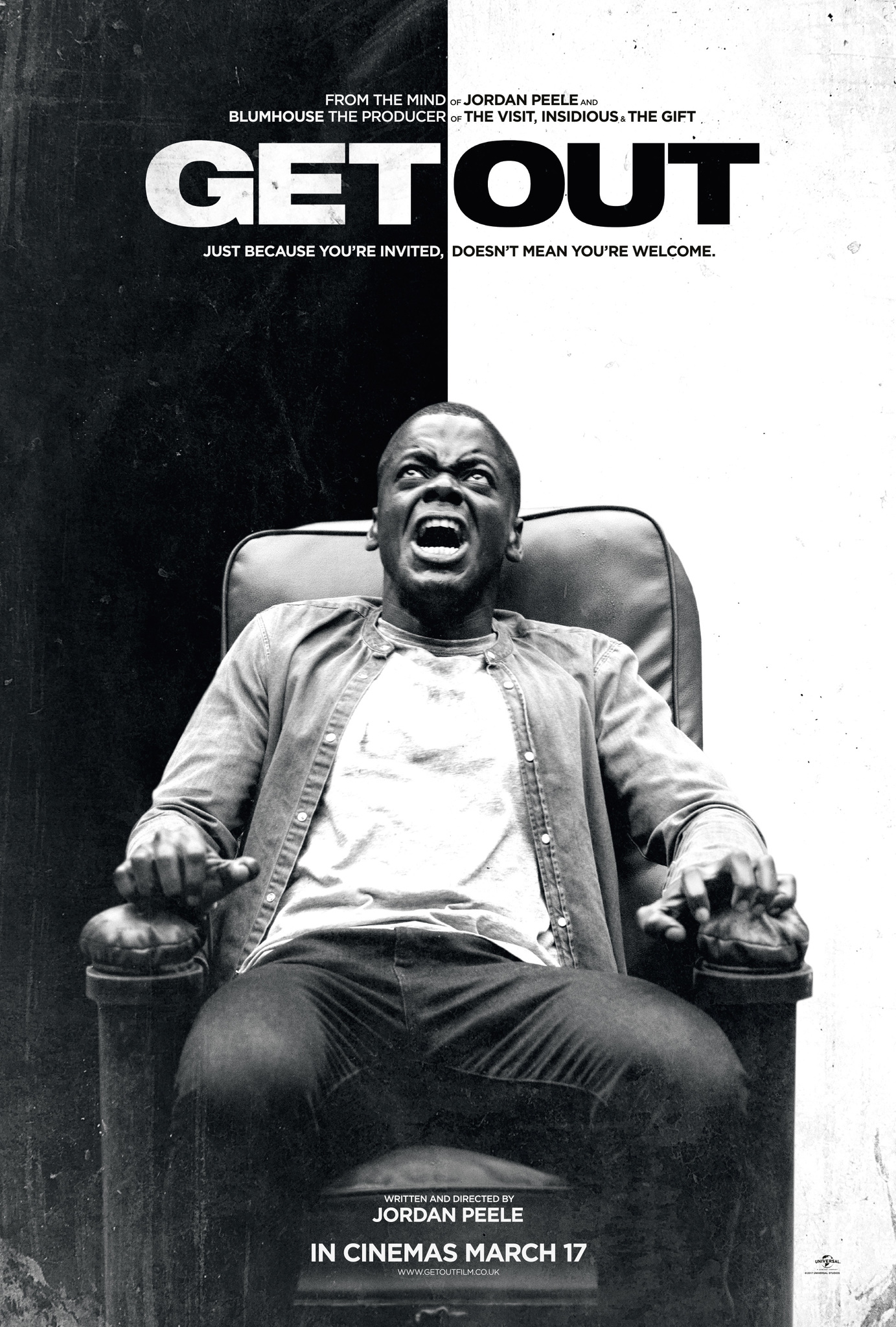
Typically, every movie's primary form of advertisement is through a few differernt forms of trailers, that give audiences a brief look into some parts of the movie. Get Out did this by showing some of the previously mentioned emotional scenes, a little bit of action, and suspenseful/climactic scenes from the movie in order to entice audiences to watch it in theatres once it's released. The largerst platform that this film's advertisements are being realeased on is on the television where it's played in between commercials for no more than 20 to 30 seconds. This film, however, didn't have much to do with online advertising unless a large screen and sound would be used. They did this to make the viewers of these trailers get the full experience of what would come in the film. One smaller method of advertisement would include critics' comments and written reviews of this film in magazines, and my co-director and I would mimic this strategy to the letter in order to achieve the most success in out advertising efforts.
This movie was a new release that centered around an interracial couple meeting the girlfriend's parents that was realeased back in 2017. Of course, the people responsible for the advertising of this movie would wany to showcase aspects of the film that would relate to viewers. This would apply to the persuasive technique of advertising by means of anxiety, fear, and harsh realizations of the world generated by a film of these genres and concepts. They did this by playing a few iconic and pivotal scenes from the movie that showed all of the emotions of the main characterbeing pushed to the extremes.
Typically, every movie's primary form of advertisement is through a few differernt forms of trailers, that give audiences a brief look into some parts of the movie. Get Out did this by showing some of the previously mentioned emotional scenes, a little bit of action, and suspenseful/climactic scenes from the movie in order to entice audiences to watch it in theatres once it's released. The largerst platform that this film's advertisements are being realeased on is on the television where it's played in between commercials for no more than 20 to 30 seconds. This film, however, didn't have much to do with online advertising unless a large screen and sound would be used. They did this to make the viewers of these trailers get the full experience of what would come in the film. One smaller method of advertisement would include critics' comments and written reviews of this film in magazines, and my co-director and I would mimic this strategy to the letter in order to achieve the most success in out advertising efforts.
Target Audience Research - Glass
The genre of Glass may have two genres differing from ours, being fantasy and drama, the thriller aspect is constant in both of our films.This category of genres come with the rating of PG-13 which means our film would then be PG-13 as well. Therefore, our target audience would be a majority of people in their younger ages, perhaps from at leats 13 to ealry-to-mid 40's; anyone who could handle and enjoy the suspense generated by the movie.
This movie is the final film to a trilogy of Unbreakable (2000) and Split (2016) which gained a lot of popularity in a short amount of time due to the fact that Split was an unannounced sequel to Unbreakable; viewers only figured this out after watching the increasingly poplular "end credits scene" that showed the main character of the forst film speaking to another person. Of course, the people responsible for the advertising of this movie would include some parts of the first two movies to help connect them and remind audiences as to why they should see it. This would apply to the persuasive technique of advertising by means of nostalgia from the prequel to this film along with the suspense and excitement generated by a film of these genres. They did this by showing a few moments of each characters' "superpowers" that were showcased in their own respected films that they starred in.

Typically, every movie's primary form of advertisement is through a few differernt forms of trailers, that give audiences a brief look into some parts of the movie. Glass did this by showing some of the previously mentioned character showcases, a little bit of action, and suspenseful/climactic scenes from the movie in order to entice audiences to watch it in theatres once it's released. The largerst platform that this film's advertisements are being realeased on is on the television where it's played in between commercials for no more than 20 to 30 seconds. The other main form of advertisement for this movie (just with Split and Glass because it was released a later time than Unbreakable) is through ads on the internet. Small pop-ups on the sides on any website will show an image of the movie poster or a short clip from a scene from the movie that will entice the viewer to click on them, be taken to the website made specifically for the advertisement for this movie, and purchase tickets to watch it in theatres. One smaller method of advertisement would include critics' comments and written reviews of this film in magazines, and my co-director and I would mimic this strategy to the letter in order to achieve the most success in out advertising efforts. However, one strategy that my co-director and I won't be following is the creation of a small strand of comic books detailing the stories of our main characters. This is because Glass centers around the concept of real life superheros that are similar to those found in comic books, but the main characters in our film aren't.
This movie is the final film to a trilogy of Unbreakable (2000) and Split (2016) which gained a lot of popularity in a short amount of time due to the fact that Split was an unannounced sequel to Unbreakable; viewers only figured this out after watching the increasingly poplular "end credits scene" that showed the main character of the forst film speaking to another person. Of course, the people responsible for the advertising of this movie would include some parts of the first two movies to help connect them and remind audiences as to why they should see it. This would apply to the persuasive technique of advertising by means of nostalgia from the prequel to this film along with the suspense and excitement generated by a film of these genres. They did this by showing a few moments of each characters' "superpowers" that were showcased in their own respected films that they starred in.
Typically, every movie's primary form of advertisement is through a few differernt forms of trailers, that give audiences a brief look into some parts of the movie. Glass did this by showing some of the previously mentioned character showcases, a little bit of action, and suspenseful/climactic scenes from the movie in order to entice audiences to watch it in theatres once it's released. The largerst platform that this film's advertisements are being realeased on is on the television where it's played in between commercials for no more than 20 to 30 seconds. The other main form of advertisement for this movie (just with Split and Glass because it was released a later time than Unbreakable) is through ads on the internet. Small pop-ups on the sides on any website will show an image of the movie poster or a short clip from a scene from the movie that will entice the viewer to click on them, be taken to the website made specifically for the advertisement for this movie, and purchase tickets to watch it in theatres. One smaller method of advertisement would include critics' comments and written reviews of this film in magazines, and my co-director and I would mimic this strategy to the letter in order to achieve the most success in out advertising efforts. However, one strategy that my co-director and I won't be following is the creation of a small strand of comic books detailing the stories of our main characters. This is because Glass centers around the concept of real life superheros that are similar to those found in comic books, but the main characters in our film aren't.
Target Audience Research - Happy Death Day 2U
The genre of Happy Death Day 2U is the exact same as the genre of the film my co-director and I are producing; horror, mystery, and thriller. This category of genres come with the rating of PG-13 which means our film would then be PG-13 as well. Therefore, our target audience would be a majority of people in their younger ages, perhaps from at leats 13 to ealry-to-mid 40's; anyone who could handle and enjoy the suspense generated by the movie.
This movie is a sequel to the film Happy Death Day that was releared back in 2017 which gained a lot of popularity in a short amount of time. Of course, the people responsible for the advertising of this movie would include some parts of the first movie to help connect the two and remind audiences as to why they should see it. This would apply to the persuasive technique of advertising by means of nostalgia from the prequel to this film along with the anxiety, fear, and excitement generated by a film of these genres. They did this by playing a few iconic and pivotal scenes from the first movie as flashbacks from the main character.
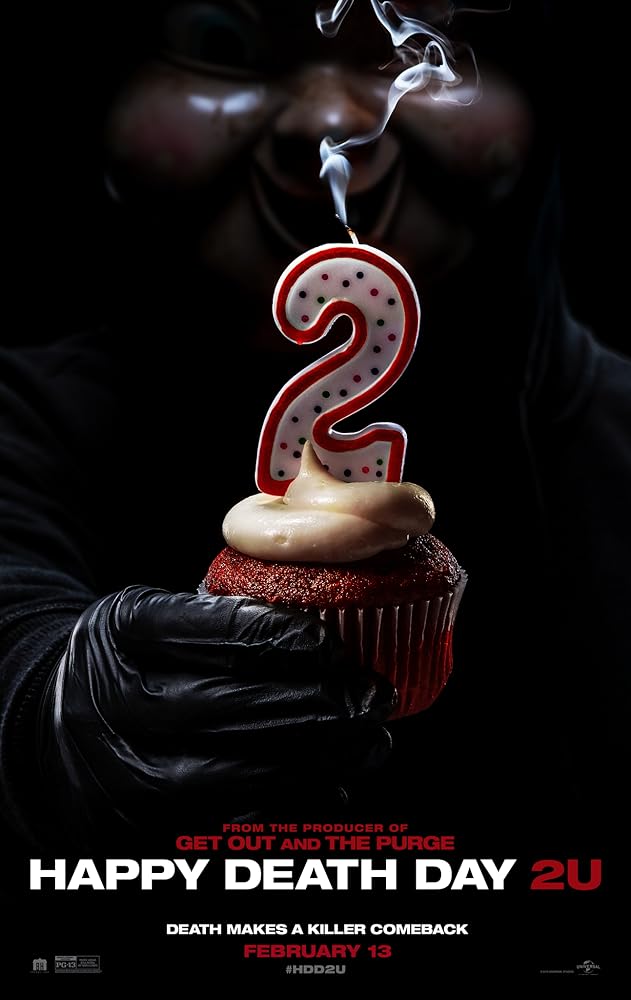
Typically, every movie's primary form of advertisement is through a few differernt forms of trailers, that give audiences a brief look into some parts of the movie. Happy Death Day 2U did this by showing some of the previously mentioned flashbacks, a little bit of action, and suspenseful/climactic scenes from the movie in order to entice audiences to watch it in theatres once it's released. The largerst platform that this film's advertisements are being realeased on is on the television where it's played in between commercials for no more than 20 to 30 seconds. The other main form of advertisement for this movie (along with almost every other movie released in present day) is through ads on the internet. Small pop-ups on the sides on any website will show an image of the movie poster or a short clip from a scene from the movie that will entice the viewer to click on them, be taken to the website made specifically for the advertisement for this movie, and purchase tickets to watch it in theatres. One smaller method of advertisement would include critics' comments and written reviews of this film in magazines, and my co-director and I would mimic this strategy to the letter in order to achieve the most success in out advertising efforts.
This movie is a sequel to the film Happy Death Day that was releared back in 2017 which gained a lot of popularity in a short amount of time. Of course, the people responsible for the advertising of this movie would include some parts of the first movie to help connect the two and remind audiences as to why they should see it. This would apply to the persuasive technique of advertising by means of nostalgia from the prequel to this film along with the anxiety, fear, and excitement generated by a film of these genres. They did this by playing a few iconic and pivotal scenes from the first movie as flashbacks from the main character.
Typically, every movie's primary form of advertisement is through a few differernt forms of trailers, that give audiences a brief look into some parts of the movie. Happy Death Day 2U did this by showing some of the previously mentioned flashbacks, a little bit of action, and suspenseful/climactic scenes from the movie in order to entice audiences to watch it in theatres once it's released. The largerst platform that this film's advertisements are being realeased on is on the television where it's played in between commercials for no more than 20 to 30 seconds. The other main form of advertisement for this movie (along with almost every other movie released in present day) is through ads on the internet. Small pop-ups on the sides on any website will show an image of the movie poster or a short clip from a scene from the movie that will entice the viewer to click on them, be taken to the website made specifically for the advertisement for this movie, and purchase tickets to watch it in theatres. One smaller method of advertisement would include critics' comments and written reviews of this film in magazines, and my co-director and I would mimic this strategy to the letter in order to achieve the most success in out advertising efforts.
Revisions - The Mother's Youthful Appearance
One of crtiques my co-driector and I received was that the relationship between the mom and the daughter was unclear to the audience. There were no dialogue markers to help indicate that the two characters were family and the mother didn't have any makeup on. This made her seem very young (almost as if they were just friends from school) and we have planned on speaking to more of our peers about help on making our mother look older. However, due to her busy schedule, our actress originally cast for the mother doesn't have the time to film with us anymore. We have found another actress who is anxious to join us and we'll keep to the idea to have help on making her look the age that a mother would.
Revisions - Change of the Murder Weapon
Due to several unexpected obstacles, my co-director and I had only one day to film with our actors and, thus, didn't leave us with much time to correct any mistakes. One of the aspects we had to improvise was the murder weapon that the mom gives the daughter. After several screening of the clip to our peers, they told us that the knife was obviously a kitchen knife used for eating and didn't seem practical as a murder weapon. When we did re-shoots after out midterm submission, we changed out the kitchen knife for one that looked more "sleek" and realistic as a weapon. The overall dark feeling it created was improved greatly by the change.
Thursday, January 24, 2019
Revisions - Quality of the Beginning Pans
During the several pans in the beginning of the clip, the daughter's room was dimly lit, making the camera unable to completely focus on certain parts of the pans. My co-director and I didn't originally believe this to be a major issue because the primary focus of the viewer was going to be on the names in the credits. We did intend to re-shoot them in our revision stages; however, after a long discussion on how we can improve our film, we decided to exclude the beginning pans altogether in order to have time at the end to include the extra final scene that we had to leave out due to the time constraints of the film. Concerning the credits that appeared on screen during these pans, they will just be shown at different parts in that beginning of the film. Lastly, the music that was played during these beginning pans will still be used, but will only be playing for a much shorter time.
Deletion of Final Scene for the Midterm Submission
In the original story board planning, the film ended with a scene of the daughter in the passenger seat of the car while her boyfriend is driving them to their date. She was supposed to slowly pull out the knife and stare intently at it to contemplate the decisions she's made (and going to make). Several close up shots, reverse shots, and zooms would've been used to help convey this. However, due to the time constraint of two minutes of the final cut of the film, my co-director and I came to the conclusion that the only way to meet the time requirement was to take out the final scene, along with two unimportant pans at the beginning of the film. We knew that the ending of the film after the deletion would still be good and still showed an ending that left questions for the viewers that would entice them the watch the rest of the film.
Thursday, January 17, 2019
Feedback/Revisions
After allowing our class to view our film, my co-director and I received many comments and feedback regarding both the features we excelled at presenting and the ones we needed to work on. Some of the positive comments we received included the unexpected well-inclusion of the pans, the good views of the camera angles, and the story line of the film in general was very interesting. Truthfully, many of the needed revisions that were received were already expected, some of them included shortening the length of the pan segment of the film, increasing the quality of the video for the bedroom scenes, and clarifying the character of the mother as the mother.
With our own new ideas and feedback we received from our fellow classmates, we've made a short list on the aspects that will be re-shot or scrapped altogether. Some of the key points that will be changed are the mother needing to look older, changing the kinfe prop for something more realistic, and reshooting the the scenes that were somewhat blurry. The main scenes that we decided to scrap altogether were many of the pans at the beginning of the film and are being replaced with a scene of the boyfriend and daughter in the car and what happens after she obeys her mother's orders. This new scene will help better define the relationship between the mother and daughter and just who the mother really is.
With our own new ideas and feedback we received from our fellow classmates, we've made a short list on the aspects that will be re-shot or scrapped altogether. Some of the key points that will be changed are the mother needing to look older, changing the kinfe prop for something more realistic, and reshooting the the scenes that were somewhat blurry. The main scenes that we decided to scrap altogether were many of the pans at the beginning of the film and are being replaced with a scene of the boyfriend and daughter in the car and what happens after she obeys her mother's orders. This new scene will help better define the relationship between the mother and daughter and just who the mother really is.
Thursday, January 10, 2019
Use of Conventions
Our film project firstly uses conventions of the thriller genre to primarily show suspense by making the audience anxious in their wonder of what the daughter will do to her boyfriend since her mother gave her a knife. It also challenges conventions because the clip is symbolic to the rest of the film in the sense that it constantly switches back and forth to the suspense of a thriller to the light-heartedness of a film that isn't. The social group that this film mainly represents are dysfunctional families where the issue is that the parents of the family act abusive towards their children and how that relationship can affect the people around them.
Subscribe to:
Posts (Atom)